

Everyone in the Operating Room, Explained
Here's who's in the room, and what every one of them is doing to keep you safe

Last week, in a post about whether you can wake up during surgery, I ended with one of the parts I love most about anesthesia:
“There are a lot of people in the operating room, and everyone has a different job. While the surgeon is focused on the operation, I am focused on you.”
When I was writing it, I realized that many people don’t actually know how many people are in the OR—or what all of their jobs are.
A typical room may have six, eight, or sometimes more than a dozen people in it. Each has been trained for a different part of the operation, and each is watching you from a different angle.
Here is what that actually looks like.

Why Are There So Many People?
Surgery used to happen in amphitheater-style rooms, with physicians and students sitting in rows above the table to watch. It was medicine, but it was also a demonstration.
On October 16, 1846, in a domed amphitheater now known as the Ether Dome at Massachusetts General Hospital, dentist William Morton administered ether while surgeon John Collins Warren removed a tumor from a patient’s neck. The gallery watched.
Once patients no longer had to be awake for surgery, everything changed. Operations could go deeper, last longer, and become more complex. Sterile technique, continuous monitoring, imaging, specialized instruments, and safer anesthesia transformed the room even more.
Some hospitals still have viewing areas or teaching rooms built into or around operating spaces. And television medicine loves them (especially Grey’s Anatomy). But in real life, I have personally never seen one used. I would actually love to hear from other medical colleagues if you have!
The modern OR still has a lot of people in it, but not as an audience. Each person is there because they are responsible for a different part of the case.
Anesthesia became its own profession. Operating room nursing became its own specialty. Surgical technologists, first assistants, perfusionists, imaging technologists, sterile processing teams, environmental services, and others took on parts of surgery that require their own training.
There are a lot of people because surgery is no longer just the operation. It is anesthesia, sterility, positioning, monitoring, instruments, imaging, documentation, specimens, implants, medications, turnover, recovery, and a hundred small checks that have to happen in the right order.
And one of the biggest things that organizes the whole room is the sterile field.
Sterile vs. Not Sterile
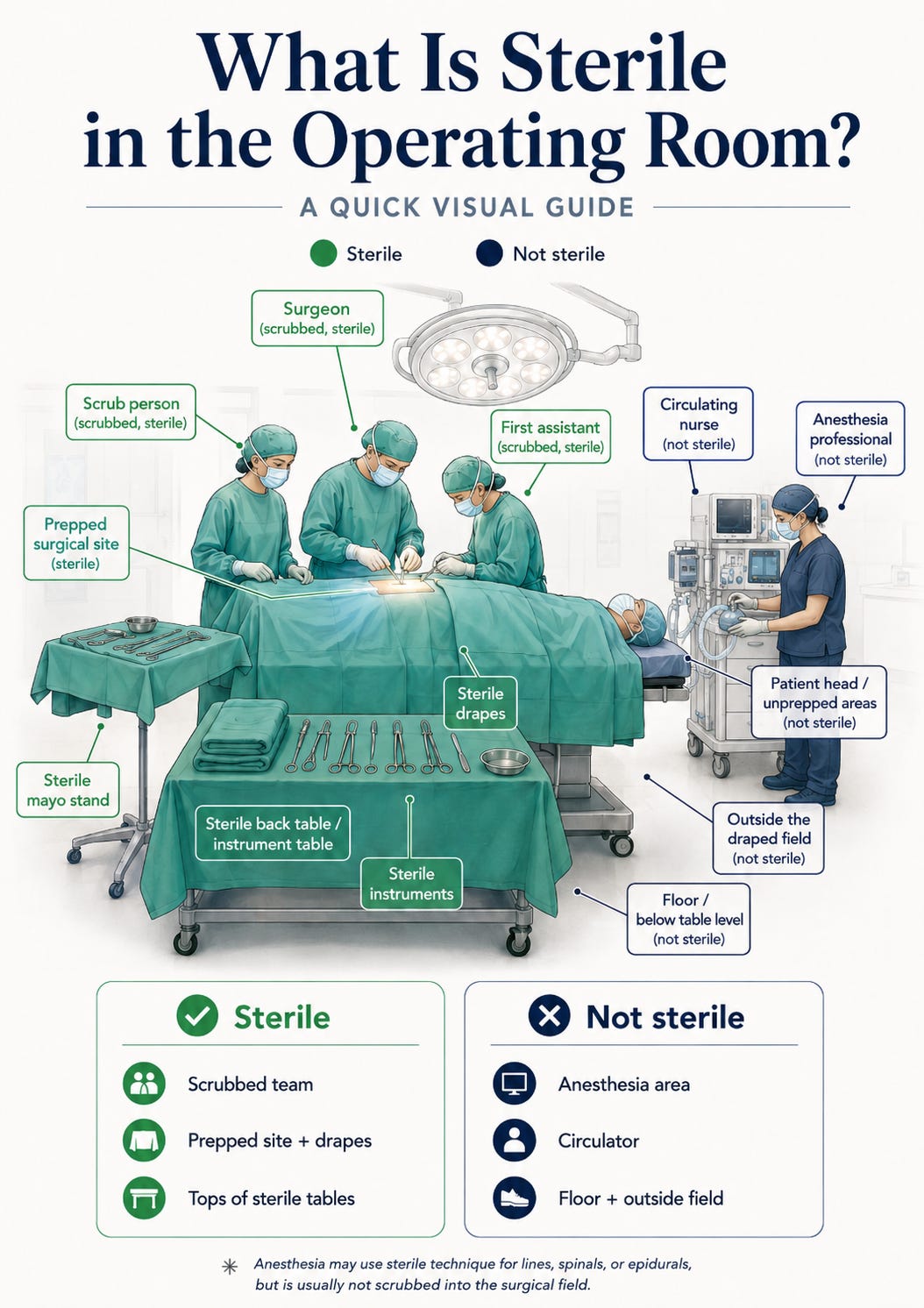
Before introducing the people in the room, it helps to understand one basic OR rule: not everyone is sterile.
Sterile means an item has gone through a validated process to destroy microorganisms, including bacterial spores, so it can be safely used in surgery. That process starts long before the patient enters the room. Instruments are cleaned, inspected, assembled into trays, packaged, sterilized, tracked, and sent back to the OR.
Once the patient is in the operating room, the sterile field is created around the surgical site. It includes the prepped skin, the surgical drapes, and the tops of the instrument tables. The surgeon, first assistant, and scrub person are usually the people working inside that field. They have scrubbed their hands, put on sterile gowns and gloves, and can touch sterile instruments.
Anesthesia is usually not sterile. There are exceptions, like when we place a central line, spinal, or epidural. But even then, we are not “scrubbed in” to the case. We are performing a single sterile procedure, then we return to our main job: taking care of the patient, not participating in the surgery itself.
The scrub person and circulating nurse are constantly protecting the sterile field. They are watching the instruments, the packaging, the drapes, the hands, and the movement around the table. All of it.
When in doubt, throw it out. That is the OR rule. If something touches a non-sterile surface, or if there is any question about whether it stayed sterile, it comes out of use. One of the most important rules we tell anyone coming into the OR for the first time — stay far away from anything blue (the color of the sterile drapes)!
At the Surgical Field: The Surgeon
The surgeon is the person most patients already know about.
They planned the operation, explained what needed to be done, and perform the surgical part of the case. They are focused on the anatomy, the disease, the repair, the removal, the reconstruction, or whatever brought you to the OR.
Across the Table: The First Assistant
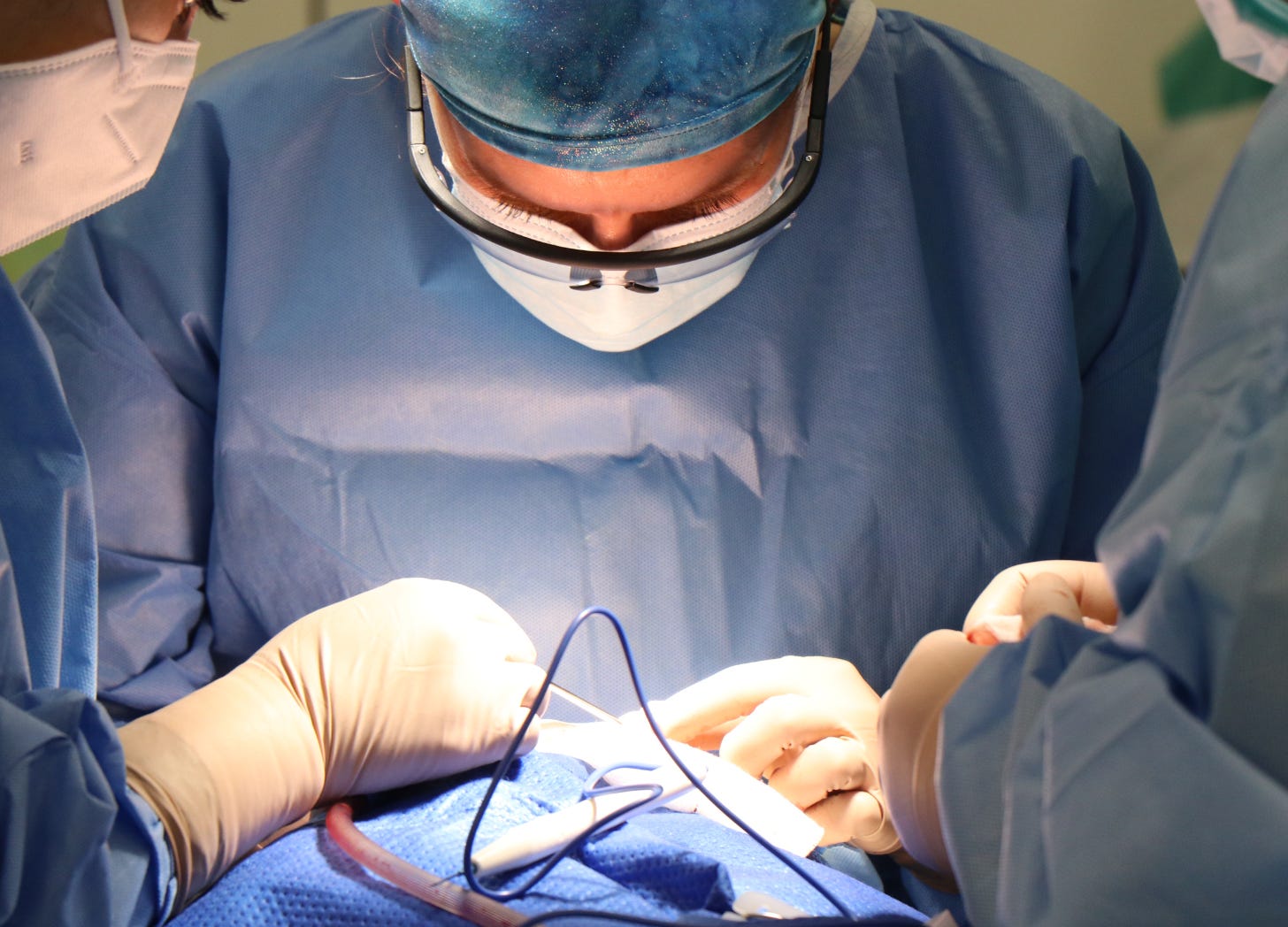
Across from or beside the surgeon is often a first assistant. This may be a physician assistant, surgical resident, fellow, RN first assistant, certified surgical first assistant, or another qualified surgical assistant, depending on the case and the hospital.
The first assistant does much more than hold a retractor (although that in itself can be a very hard job). They also help expose the surgical area, suction blood or fluid out of the way, control bleeding, handle tissue, place or cut sutures, assist with closure, and keep the operation moving safely.
A typical first assistant is always anticipating, watching where the surgeon is working, what is blocking the view, and what will be needed next. During a long case, the rhythm between the surgeon and first assistant is often wordless.
A surgical PA has completed a master’s-level PA program, passed national boards, and may have additional surgical or specialty training. A resident or fellow is a physician in surgical training. An RN first assistant is a registered nurse with perioperative experience and additional first-assist training. A certified surgical first assistant usually comes through a surgical technology or surgical assisting pathway and has completed additional education and certification.
I have spent most of my career working closely with many PAs in particular. After enough years and enough cases together, you learn one another’s patterns. They know the jokes I tell my patients and the things I am paranoid about. I know how long it usually takes them to close and who I can ask about specific parts of a procedure.
At the Instrument Table: The Scrub Person
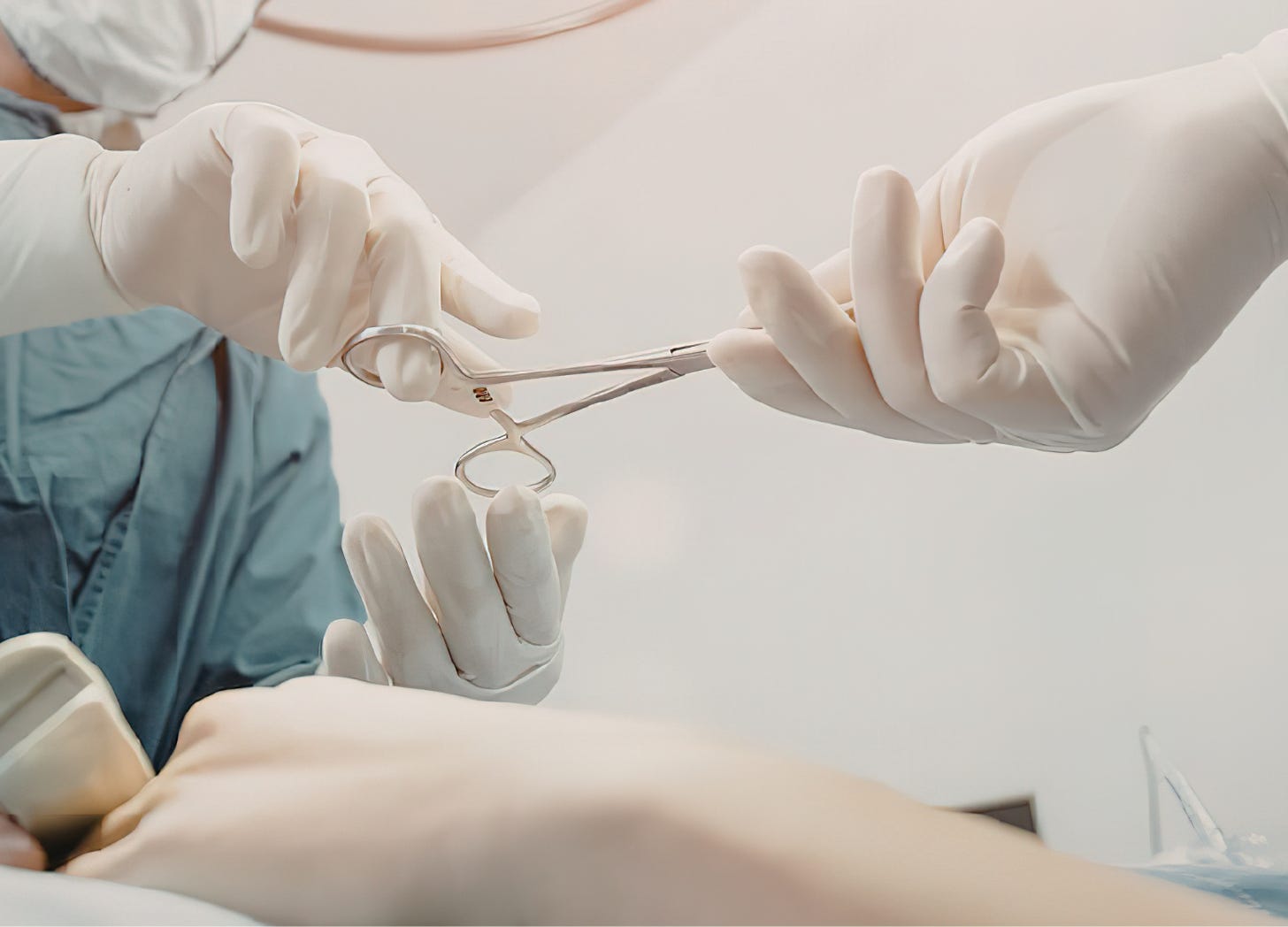
The scrub person is usually a surgical technologist or sometimes a registered nurse. They organize the sterile instruments and supplies, pass instruments, manage sutures, handle specimens, and help protect the sterile field.
Watching an experienced scrub person work can look like choreography. They usually know which instrument the surgeon will need before it is requested and will have it ready to grab without the surgeon needing to look.
Most scrub persons are surgical technologists who completed a surgical technology program and passed a national exam to become certified. Their training includes anatomy, microbiology, sterile technique, instrumentation, and the flow of many different procedures.
The person at the instrument table has to know the names of the instruments, what they are used for, and when the surgeon is likely to need them. Some trays have dozens of pieces. Some have more. The scrub person has to know what is there, what is missing, what has been used, and what needs to stay sterile.
They also share responsibility for the count. Sponges, sharps, and instruments are counted at specific points during the case by the scrub person and circulating nurse together. If the count does not match, the entire room stops and the discrepancy has to be resolved.
The Person Who Sees the Whole Room: The Circulating Nurse
Someone has to be free to move. That’s the circulator.
The circulating nurse is a registered nurse who works outside the sterile field. While the surgical team is focused on the operation and I am focused on your physiology, the circulator is watching the whole room.
The patient. The positioning. The documentation. The equipment. The implants. The specimens. The supplies. The timing. The count.
They confirm your identity, procedure, allergies, consent, positioning, equipment, medications, and supplies. They document what happens. They open sterile items without contaminating them. They manage specimens. They count with the scrub person. The circulator is constantly scanning.
The training starts with nursing school and RN licensure, but OR nursing is its own specialty. New circulating nurses usually need months of perioperative training after they are hired, and then years of experience to get really good. Many go on to earn CNOR certification, which requires at least two years and 2,400 hours of perioperative nursing practice.
And Then, Depending on the Case
Other specialists join when needed.
A perfusionist may run the heart-lung machine during cardiac surgery.
A neuromonitoring specialist may track signals through the brain, spinal cord, and nerves during certain neurologic, spine, or vascular procedures.
A radiologic technologist may operate imaging equipment during orthopedic, spine, vascular, or interventional cases.
During cancer surgery, the operation may pause while a pathologist examines tissue and reports findings back to the surgeon.
There may also be residents, fellows, PA students, nursing students, medical students, or student nurse anesthetists. That is how every one of us learned, with responsibility matched to training and supervision.
And then there are the people patients almost never see: the sterile processing team sterilizing instruments, the environmental services team cleaning and turning over the room, the aides and transporters helping move and position patients safely, the pharmacy staff preparing medications, the lab and blood bank staff ready if the case needs them, the PACU nurses waiting on the other side.
A single operation depends on far more people than can fit around the table.
You Are Not Alone
You won’t meet most of these people. You won’t see the coordination, the rhythm, the way everyone knows exactly what to do without being told.
But they’re all there. Focused on you.
Add up the years of training standing around one operating table, and it is usually measured in decades. Everyone in that room has a different job. But everyone in that room has the same goal: to take care of you.
I am focused on you. And everyone else is focused on you too — just from a different angle.
For those of you who work in an OR: Who controls the music in your room, and which specialty has the most predictable playlist? Reply and tell me.
If this gave you a different understanding of what happens in an operating room, share it with someone who’s having surgery. Knowing who’s there and that they’re all focused on keeping you safe makes the whole thing feel less scary.
The Art of Anesthesia explains what actually happens before, during, and after anesthesia — and the parts patients rarely get to see.
Subscribe for weekly posts breaking down what actually happens during anesthesia and in the OR. New posts every Thursday. It’s free.
Thank you for sharing! I would love to read a piece from you about emergence delirium or pain management post op as an anesthesia provider.
Wow! Being someone who has had five operations in four years, all requiring anesthesia, this certainly enlightened me.
I knew before I was put under, that each time there were a lot of people in the room, but then I was only looking up at the ceiling, I never really knew what each person was doing.
This was great information, I wish I’d known before the first operation, which was an open heart surgery, back in 2022. Thanks for sharing!