

What the Anesthesia Machine Actually Does While You’re Asleep
The Machine and the Breathing System: Part 1

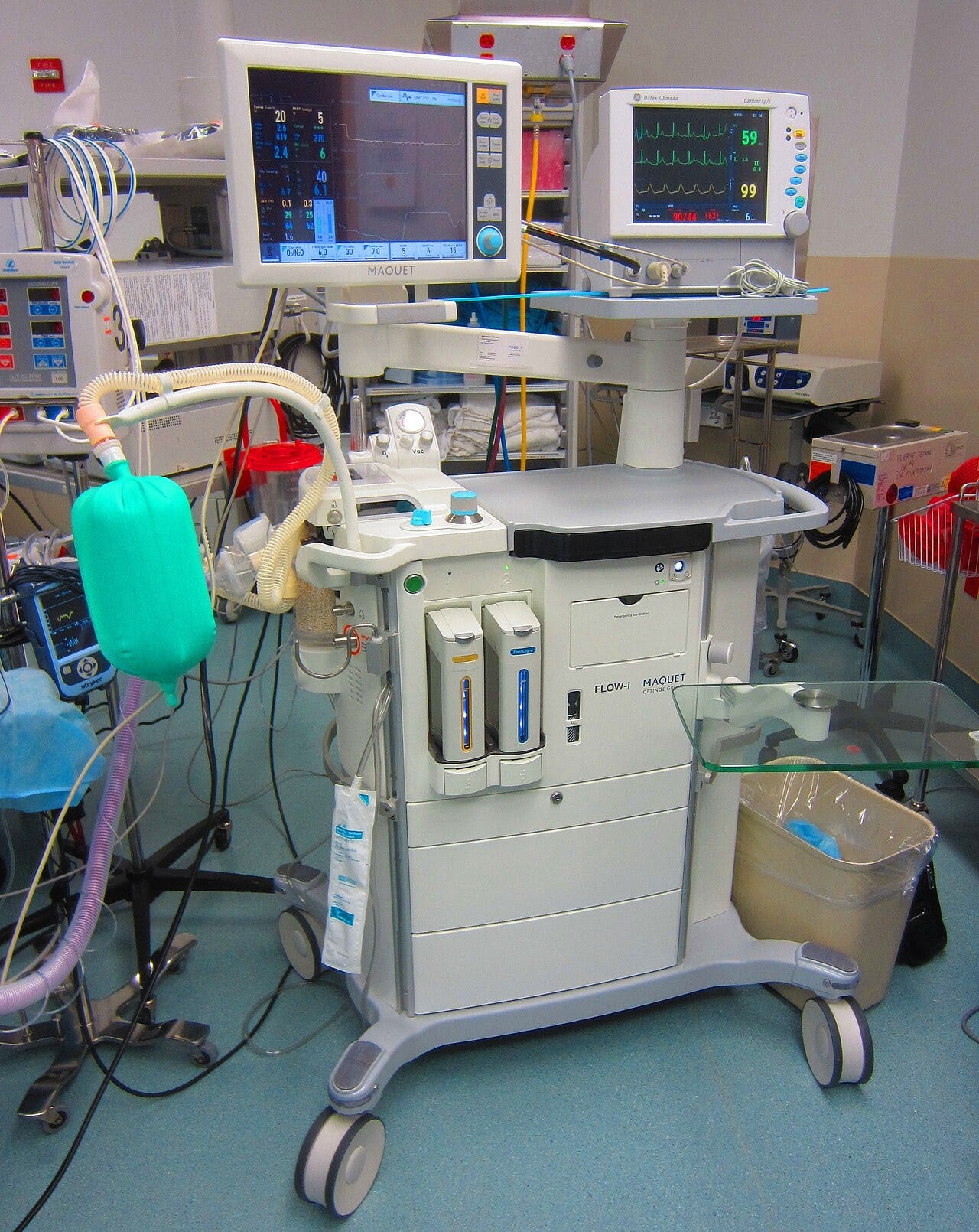
The anesthesia machine usually sits right next to your bed in the operating room, but most people never notice it. You may have caught a glimpse of one in medical dramas, movies, or reality TV, but in real life, it tends to blend into the other equipment—monitors, IV poles, lights, cords, and noise of the room.
Even when people do notice it, they usually think of it as “the machine that puts you to sleep.”
It’s not. The machine does not perform anesthesia by itself. The anesthesia team does that. The machine just gives us a controlled way to deliver oxygen, add anesthetics, support your breathing, remove carbon dioxide, and monitor what you are breathing in and out.
It is part ventilator, part gas delivery system, part monitor, and part safety system. And one of the first things anesthesia providers learn is not just how to use it, but how it works — the chemistry, physics, mechanics, alarms, pressure limits, vaporizer safeguards, breathing circuit checks, and backup systems built into it.
We are also expected to troubleshoot it when something goes wrong, often in the middle of surgery, while you are asleep, and everyone else is focused on the operation.
Every day, we check the machine before it is used. Before every case, we check it again. Next week, I’ll get into those checks and the safety systems behind them. But first, I want to explain what this machine is actually doing while a patient is under anesthesia.
The Basic Loop: How It Works
At the highest level, the anesthesia machine is built around a loop.
Oxygen and other medical gases enter the machine under pressure. The machine reduces and controls that pressure, allows us to set exact flow rates, and can add inhaled anesthetic vapor. That gas mixture then travels through the breathing circuit to the patient’s lungs.
When the patient exhales, the gas comes back through the circuit. We measure what is coming back, remove carbon dioxide, and continue the cycle.
That is the basic loop: gas in, gas out, measured continuously.
During general anesthesia, a patient may not be breathing normally. They may not be protecting their airway. They are also not awake to respond to low oxygen, rising carbon dioxide, airway obstruction, or changes in ventilation the way they normally would.
The anesthesia machine helps us support those functions while giving us continuous information about what is happening. It does not replace clinical judgment. It gives us the data, the controls, and the safety systems we need to manage a patient while they are anesthetized.
One of the most useful parts of the machine is that we are not just delivering anesthetic gas and hoping it is working. We can measure what the patient is inhaling and what they are exhaling. The exhaled anesthetic concentration gives us important information about how much anesthetic is actually reaching the patient.
Oxygen Comes First
The most important job of the anesthesia machine is to deliver oxygen.
Oxygen moves through the anesthesia machine, into the breathing circuit, and then to the patient through a mask, breathing tube, or other airway device. From there, it reaches the lungs, crosses into the blood, and is delivered to the brain, heart, and the rest of the body.
In everyday life, you breathe room air, which is about 21% oxygen. During anesthesia, we can adjust the oxygen concentration depending on what the patient needs. Around major transitions — like going to sleep or waking up — we often deliver a higher percentage of oxygen to build up a reserve. We may also use more oxygen if a patient’s underlying disease, positioning, or the surgery itself makes oxygenation more difficult.
But higher oxygen is not always better. In some cases, especially when surgery involves the airway or other fire-risk situations, we may intentionally lower the oxygen concentration to reduce the risk of operating room fire. So oxygen delivery is not simply “more is better.” It is something we adjust throughout the case based on the patient, the procedure, and what is happening in real time.
Once oxygen is moving through the machine, the next question is what else can be added to that gas mixture. For many general anesthetics, that is where the vaporizer comes in.
How Anesthetic Vapor Gets Into Your Body
When people talk about “anesthesia gas,” it can sound like there is simply a tank of anesthetic gas connected to the machine. That is not usually how it works.
Some anesthetics, like nitrous oxide, are delivered as gases. But many of the inhaled anesthetics used in modern anesthesia, including sevoflurane and isoflurane, are liquids at room temperature.
Before they reach the lungs, they have to be turned into vapor.
That is what the vaporizer does.
The vaporizer sits on the anesthesia machine and adds a controlled amount of anesthetic vapor to the fresh gas flowing through the system.
For most modern vaporizers, some of the gas passes through a chamber that contains the liquid anesthetic. As it moves through that chamber, it picks up anesthetic vapor. That vapor then rejoins the rest of the fresh gas flow before traveling through the breathing circuit to the patient.
When I change the vaporizer dial, I am changing how much anesthetic vapor is added to that gas mixture.
This is more engineered than it looks. Liquid anesthetics do not evaporate the same way under every condition. Temperature, pressure, flow, and the properties of the anesthetic itself all affect vapor output. Modern vaporizers are built to compensate for those variables so the delivered concentration stays predictable.
Desflurane is the unusual one. Its boiling point is close to room temperature, and its vapor pressure is high, so it requires a heated, pressurized vaporizer rather than the standard design.
Why the Dial Isn’t What Your Body Gets
One thing that is not obvious from the outside is that when I turn the vaporizer dial, the change does not instantly appear in the patient’s lungs.
The gas still has to move through the machine, travel through the breathing circuit, mix with gas already in the system, and reach the patient. At the same time, the patient’s body is continuously taking up an anesthetic.
This is where fresh gas flow matters. Higher flows usually make changes happen faster. Lower flows usually make changes happen more slowly. The size of the machine and the breathing circuit also matter. If there is more gas already sitting in the system, it takes longer for a change at the dial to fully reach the patient.
This is why anesthesia is not managed by dial setting alone.
We watch what the patient is breathing in. We watch what the patient is breathing out. We watch oxygen, carbon dioxide, ventilation, airway pressure, blood pressure, heart rate, surgical stimulation, and how the patient is responding over time.
The dial is one control. It is not the whole picture.
What the Machine Is Really For
At the highest level, the anesthesia machine exists to make anesthetic delivery controlled, measurable, and adjustable.
It gives us a way to deliver oxygen, add inhaled anesthetics, support or control breathing, remove carbon dioxide, and measure what the patient is breathing in and breathing out.
But the machine does not manage the anesthetic by itself.
The machine provides the equipment and the measurements. The patient’s body provides the physiology. The anesthesia provider has to interpret what is happening and decide what to do next.
That is the part that is easy to miss from the outside. The anesthesia machine is not just a collection of tubes, dials, screens, and alarms. It is a system we use continuously throughout a case to make decisions.
Next Week
Next week, I’m going to get into the safety systems built into the anesthesia machine: the alarms, the machine checks we do before the day starts, and the shorter checks we repeat before every case.
This is where the machine gets even more interesting. It is not only designed to deliver oxygen, anesthetic vapor, and ventilation. It is also designed to help us detect problems early — before they become emergencies.
If you have questions about how the anesthesia machine works, leave them in the comments.
Subscribe for weekly posts breaking down what actually happens during anesthesia and in the OR. New posts every Thursday. It’s free.
I find it fascinating
This post came at no better time, as I take a coffee break from working on my application for anesthesia school. I get a good sense that, despite the machine’s brilliance, the anesthesia provider remains superior and indispensable in making those critical decisions. Nice work Jenni!